Sunday, April 20, 2014

Interview with Joe Meno


There are probably few people out there who have more experience within the LEGO community as Joe Meno. 

Joe has been a central figure in LEGO community for well over a decade. He publishes the AFOL (Adult Fans of LEGO) magazine BrickJournal, and co-wrote Cult of LEGO, which is a great book that I have used as a reference for my project so far. 

On top of being a writer/editor/publisher, Meno is also an accomplished LEGO builder who displays his creations at LEGO events, as well as online. 

Images of Joe's creations, as well as posts regarding all different sorts of LEGO, can be found on his 
personal blog.


Milo Krimstein: Can you tell me a little bit about who you are, and what is your background in the LEGO community? 

Joe Meno: I am a former graphic designer who became a magazine editor for the LEGO hobby. Basically, I moved my profession to my hobby. I got back into LEGO building in 1999, when I got a job at the LEGO Imagination Center in Orlando, Florida. I didn’t last that long in that job, but I discovered the online LEGO community and eBay soon after, which pretty much doomed me :-). From that beginning, I got involved in the community by first attending conventions then volunteering for events and finally leading a couple. Somewhere in there, I kept on building and began thinking about doing a magazine, which was launched online in 2005 and printed two years later. Because of my activities, I have participated in a few LEGO projects, including set design and beta testing of LEGO software.
Meno's LEGO publication,
BrickJournal. 
MK:  What kind of a role would you say that you play in the LEGO community?

JM: My role now is mostly a journalist and advisor. My building is still known, but nowhere as much as the magazine.

MK: Is LEGO a toy, or is it more than a toy? How and why?

JM: It’s more than a toy - it’s a medium. While childish can play with the brick, adults can use the brick as an art medium or prototyping material, for starters. The simple building system makes building accessible to those ‘non-creative’ builders who are engineers or math-based. A LEGO set can make a 2-D mosaic, a 3-D model, or a functioning robot, so saying that LEGO is just a toy is simplistic.


Students use LEGO Mindstorms in the
First Lego League. 
MK: In what ways can and/or do you use LEGO as a tool for education?

JM: I use the MINDSTORMS system for robotics classes in the summer and at school and help the same school with FIRST LEGO League. LEGO building is also used for storytelling by having kids build something and then talking about it afterwards.

MK: How has LEGO, and the culture surrounding LEGO, evolved from the past to the present?
JM: LEGO has progressed from bricks to wheels to figures to machines to computers….the culture has progressed from exclusively play to becoming a form of expression to adults and children.

MK: What does LEGO represent in our culture? 

JM: Childhood on one level and creativity on another.

MK: What might the future hold for LEGO and the LEGO community?

JM: Tough one - LEGO is the best building brick out there now and the current challengers are not very strong. The biggest challenge may be coming from 3-D printing: why buy sets if you can make your own parts? How LEGO deals with that will determine how the community goes. 


Wednesday, April 16, 2014

Interview with Rocco Buttliere

LEGO World Financial Center (NYC)


Rocco with his models at
Brickworld, Chicago
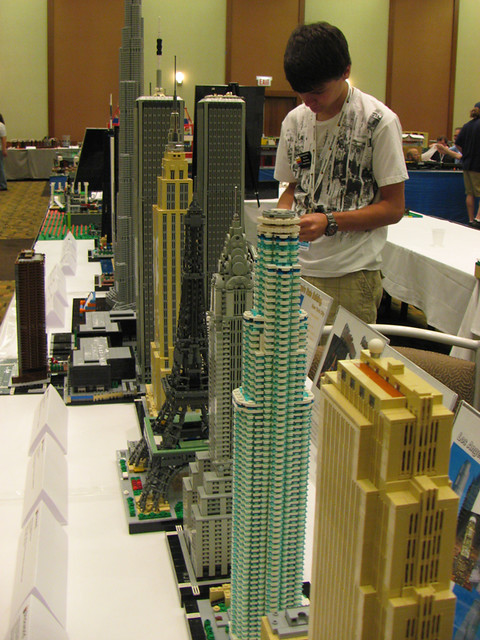
Rocco Buttliere builds LEGO models that are so elaborately detailed and articulate that many people don't realize the models are built from the kids toy until they take a closer look.

Only a few years older than myself, Rocco has undeniably mastered the craft of recreating architectural skyscrapers and landmarks using any and all of the LEGO elements that exist. He uses his bricks both wisely and creatively, and seems to produce a new Chicago skyscraper model every few months. Pictures of all of his LEGO creations can be found here. (I highly suggest taking a look: there are some really extraordinary techniques to appreciate in his builds).

By the way, I should note that all of his models are built on the same scale: 1:650

Trump International Hotel & Tower next
to the Wrigley Building
MK: First of all, tell me a little bit about yourself and your background with using LEGO.

RB: I am currently a second year architecture student at Illinois Institute of Technology in Chicago.  Having grown up in Buffalo Grove, just northwest of the city, I have always loved the downtown area and all the excitement it has to offer.  I started building LEGO sets at the age of six, and slowly worked my way beyond building just the sets.  When I was fourteen, around the time I started to show an interest in architecture, I began building skyscrapers out of LEGO as a personal hobby.

MK: Why do you work with LEGO to recreate skyscrapers and landmarks? What are advantages, challenges, and benefits of working with LEGO as opposed to other mediums?

Chicago Board of Trade
RB: I really started to build skyscrapers and landmarks after I had built some of the larger sets LEGO had to offer such as the Eiffel Tower and Taj Mahal.  When I built my first skyscraper model, which was the Sears Tower, I saw it as a way to make a comparable landmark model at a reasonable scale, while serving as a tribute to my own locale.  The main benefit of working with LEGO as a medium is that it gives each model I make a more sentimental quality.  LEGO itself is an undeniably more innocent medium than, say, oil paint or plaster.  The challenge and enjoyment I find it in, however, is that I can take this medium and use it in such a way that can be used to visually represent an existing structure.  Enough so as to be possibly deceptive to an unknowing person that the model is actually made of LEGO.

MK: What have you learned from LEGO? What can others learn from LEGO? Can you apply any of the knowledge you may have gained from working with LEGO to anything other than LEGO building?

Building things at such a small scale, for me, can teach many things that are applicable to a wide variety of activities or areas of study.  For instance, figuring out how to make the interior of a model support the exterior finish is not unlike the way in which engineers discover new techniques and methods of construction.  
Chase Tower (Chicago)

MK: Your models are extremely technical, and I hear you are studying architecture at Illinois Institute of Technology. Has LEGO shaped who you are as a thinker and creator? If so, how? Did construction toys such as LEGO play a role in igniting your passion for architecture?

RB: LEGO has most definitely shaped the way I think.  I would venture so far as to say that it's really similar to how it's easier to learn new languages when starting at a young age.  I think starting out so early and keeping that going for the majority of my life has definitely made me think more technically and creatively.  

MK: Do you consider yourself a part of a LEGO community? If so, how has being a part of that community helped you grow as a builder?

RB: I definitely consider myself as part of the LEGO community.  I'm a member of the Kenosha LEGO Users Group (KLUG) and the Chicago Area LUG (ChiLUG), and I regularly attend Brickworld Chicago in June, not to mention I even worked at a LEGO Store for the holiday season a few years ago.  Putting yourself out there with other people who build is really beneficial to you as a builder.  Not only do you see other builders' techniques and building methods, but you're able to get feedback on your own methods as well.

(from left) One Prudential Plaza, Two Prudential Plaza,
Aon Center, Aqua, and the Blue Cross Blue Shield tower


Monday, March 31, 2014

My Brickology Experience!

Brickology  is a class that Beth Weis (A LEGO professional) runs. Beth has been sponsoring my LEGO project and has been an excellent resource for my project.


The concept of the class is to encourage kids to build with each other, learn from each other, use their creativity and to have fun. I wish I could have taken a class like Beth's when I was a young boy, because it is simply awesome. Every week we work on a different project with the kids, and every week the project we work on is cooler than the previous one. Beth's class is great, because through helping her I have witnessed firsthand some of the amazing things that LEGO can do.


The sphere that we made!
During the first week, we taught the kids how to build little LEGO spheres. I thought this was a great project, because it was certainly challenging for the kids but they learned from each other when they struggled. Some kids even learned a little bit about geometry during the project, as one boy realized "Wow! We're turning cubes into spheres!" The kids were amazed when they all had their own little spheres.
I think the coolest thing about the sphere project was the fact that it introduced the kids to some of the really cool things you can do with LEGO once you manipulate the way pieces can go together. The kids were visibly curious about how on earth the sphere was made, and how we "got the bumps to point in different directions." Not only young kids, but a lot of people don't fully realize the possibilities that a simple 1x1 brick with a stud on the side can present.


Working on the tower
For the Second week , the project we worked on was the signature Brickology project-- building a "tower", or large circular wall, out of multicolored 1x8 bricks. Beth and I constructed the circumference base, and then the kids came and puts the bricks on top of each other until the tower was taller than they were! It was a thrill to see how excited some of the kids were about this project. Once the tower was completed, we took some bricks out from the base to allow the kids to crawl through and go inside, where we took a picture of them all. This "tower" project is Beth's signature project since she does them at birthday parties and events, as well as at her classes. She usually writes a word or two in the tower using bricks.

To see pictures of all the different towers she has built (with what seems like a million different names), follow this link: http://www.bethweis.com/pages/event-pictures.php

The third week was the most fun of all the projects we've done so far. Beth and I brought two LEGO tubs full of large, modular castle pieces. There were also a lot of flower bricks, columns, fences, and harry potter-style castle roofs. The kids all built their own castles, and they all looked really extraordinary. According to Beth, you really can't go wrong with this project, as the kids love building gardens for their castles and building castles in general. While they all looked great, and they were all very symetrical (these are kindergardeners we're talking about!) there was one castle that really stood out. What wowed me was how the kids decided to make a "pond"... which was to take all the blue flower pieces and fill a hole in the base with them! I was super impressed with the creativity and enthusiasm all of the kids had while building the castles.

Overall, helping Beth has been a huge amount of fun. It has also been very insightful for experiencing firsthand how kids use LEGO to develop creativity, experiment, and have fun with one another.


Friday, March 14, 2014

LIKE this project on FACEBOOK!!

https://www.facebook.com/LEGOeths

This project has its own facebook page, and if you like what I'm doing and are interested in seeing more updates, please give this page a LIKE!

thanks!

Tuesday, March 4, 2014

LEGO ETHS- The Design Process

I am building my high school (Evanston Township High School) out of LEGO. If this is your first time reading my blog, heres an overview of what my plan is:

like I said earlier, I'm building a LEGO model of my high school. I plan to buy the digitally design the model, buy the pieces and construct it. When completed, I wish to donate the model to my high school. At first, the model was going to be the entire school, and to be built on a very small scale. (ETHS is an enormous school, so the final product would still have been quite large.)

My intention was for the model to be built on a very literal, yet small, scale similar to the Adam Reed Tucker's LEGO Architecture sets.

A screenshot of the design idea I
scrapped in favor of the Minifig model.
The most developed part of this
model is the section I ended up choosing
to build on Minifig scale.
A bird's eye view of the High School
(image courtesy of Google Maps)

However, after a little while designing the school on that scale I decided to change my design entirely. I started a new minifig scale model (on the same scale as a LEGO man) of the high school.

Since the school is so big, i'm only really to be able to build the front part of the school on minifig scale. Thats fine with me though, because the front is the most iconic section of the building.

The portion of the school I will be building on mini-figure scale.
The final model should be roughly 66 studs (lego bumps) wide and
48 studs long. 


   While designing, I had to think about the amount of pieces I was using. I didn't want to create a design that would end up being a fortune to pay for (my current budget is supposedly estimated to be around 1500 dollars). Budget details are still being figured out.
   Another thing to consider while designing is the issue of making sure everything can be not only built but supported when constructed in real life and not on a computer.

My progress as of March 4th, 2014.
I've been doing a lot of de- and re-construction on the model to make sure everything is solid and supported by pillars.

The reason the model is split in half in the image on the left is because I figured the school is largely symmetrical, so to save time and simplify the design process I'll just work on a single half and order double the pieces when finished.


That's it for this update. I'll be taking lots of screenshots as I design (and pictures as I build) so expect more updates on the project soon!


Wednesday, February 26, 2014

The LEGO Movie Title Sequence

A rather brilliant interview was shared on The Brothers Brick this morning about the process behind the closing credits of The LEGO Movie.

I didn't realize that the credits were done with actual LEGO using stop motion animation (rather that CGI, which is how the rest of the movie was made). I definitely suggest checking out the interview with Creative Director Brian Mah, VFX Supervisor James Anderson, and Executive Producer Kathy Kelehan of Alma Mater

Here's a link to the article, which was posted by Art of the Title:
 http://www.artofthetitle.com/title/the-lego-movie/#

One part of the interview that made me very happy was the fact that they actually used Lego Digital Designer-- the same program I'm using-- to create the micro scale settings for the title sequence!

Brian Mah's description of LDD:
A screenshot of some recent progress on the school design,
which is, of course being done on Lego Digital Designer
" It’s a free program that anyone can download online and it played a huge part in our design process. It’s like a user-friendly CAD program for building with Legos. It was originally created so that people could virtually build an object, then export a shopping list of which parts they needed to order to build it in real life. Once you get the hang of it, it’s a really fun program to use! It’s very realistic — everything you build literally has to be created the way you would build it in real life, brick by brick. It won’t allow you to put pieces together that won’t connect in reality. This made it a double-edged sword, in a way. "

Many interesting topics are discussed in the interview, from details in the design process to the animation and even the music! 

I highly recommend giving it a read. 

Sunday, February 16, 2014

The LEGO Movie- my review!

by Milo Krimstein

As a kid, making strop-motion movies with LEGO bricks was my second favorite thing to do, behind only building LEGO. The movies were often short, nonsensical, and poorly animated, but the process of making the film with my friend was where the real fun always was. You can view our YouTube page here. When I heard that the LEGO movie was being made, I knew I would see it as soon as I could.

So, the other day I saw The LEGO Movie, and I'm pleased to say that it exceeded my initial expectations and lived up to the high praise I had heard from everybody who had seen it before me.

Lincoln, Superman and
Lady Liberty
Watching the trailers before the movie started, I really realized that kids movies have become incredibly The LEGO Movie really breaks the mold, using wit, outstanding animation, strong voice actors and an overall theme of, well... being creative.
generic, as animation style and plots are almost identical nowadays.

Although it wasn't made using stop-motion animation (it would be too difficult to pull off, seeing as LEGOs are so small) the movements were very true to plastic mini figs, and just about the entire film is made entirely out of lego. (I mean EVERYTHING... the water, the backgrounds, the sky, everything is realistically depicted as being made from individual bricks.)

Making a movie based on a toy has been done before, and it is understandably a shaky subject matter for feature films to revolve around. LEGO is unique because unlike GI Joe or Transformers, LEGO products aren't entirely focused on story lines, but rather construction, creativity, and craft as much as (or more than) characters. Of course, LEGO has licensed products all over the place, so there are plentiful characters from the history of the LEGO universe, which is a lot of fun.* The way the movie was made to respect the uniqueness of LEGO, and it does so in many creative and efficient ways.

It's clearly very hard to produce a movie that appeals to both kids and adults, but if I had to choose one thing that kids and adults both adore, it would clearly be LEGO. Right from the beginning, the movie is packed full of busy LEGO environments and quick dialogue. It was a bit difficult to digest exactly what was happening at the beginning, but I quickly got adjusted to the fast, almost sugar-rush pace of the film. Just like the LEGO characters (and Emmet's head in one particular scene), my head was spinning. Not a single second is wasted by Phil Lord and Christopher Miller, as visual gags and energetically animated LEGO characters clutter the screen. While a part of me was a little bit uncomfortable with the rapid pace of The LEGO Movie, towards the end (I won't spoil anything) it becomes clear that the movie just wouldn't work without the constant stream of action, silliness and colorful characters and settings. After all, it is a kid's movie.

As a LEGO fan, I loved this movie because of how much homage it pays to LEGO's history and culture. I loved how the LEGO construction workers used builder's slang as they constructed skyscrapers brick-by-brick in an opening scene. "I need a one by four brick! Four by six grey plate needed over here!" These are things you could hear actual LEGO builders saying, so I thought it was pretty awesome.

I wonder if we will ever see a Minecraft movie? I figure that is a "toy" that has a similar potential as the LEGO movie.

This movie is not only a must-see for anybody (regardless of age) who considers them a LEGO fan, but for anybody who would like to see how the inventive minds of Chris Miller and Phil Lord have essentially pushed the genre of kids movies forwards.

Overall, I would give the LEGO Movie two "lego-claws" up... because lego men don't have thumbs.


*I noticed in the LEGO Movie that there are DC characters but not Marvel characters. This is obviously due to a licensing things, but seeing as they've already reached a deal on the sequel, I would hope to see Spidey and Wolverine in the next LEGO flick.